



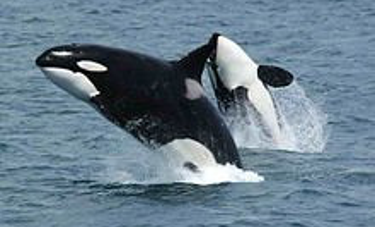
Who doesn't like orcas, close the door behind you.
In captivity there were several attacks, including fatal, but they were caused by almost human reasons like losing a mate or being depressed from staying in confinement and orcas never tried to eat humans. In the wild when members of the pack were killed by whale hunters, orcas drowned the ships and leaved humans unharmed. Also orcas used their hunting techniques on filming crews (generated waves to turn over a boat same as they did to wash off seals from ice) but didn't try to attack humans.
Orcas have the second-biggest brains among all ocean mammals, they can mimick other animals voices and inhabit very different areas, developing different skills, their most developed part of the brain is the one responsible for processing large data and fast thinking, not so much the one responsible for consciousness, so maybe they don't actually like humans, just don't see them as prey idk.



Jump in the discussion.
Become a member of +Trivia, no email address required. Take ThePinkPill.
They are matriarchal.
https://wildwhales.org/speciesid/whales/killer-whale/
Natural History
Killer whales along the coast of British Columbia and Washington are some of the best-studied whales in the world. Intensive field research in this region has been in progress for almost 30 years. In the early 1970’s photo-identification of killer whales was established by the late Michael Bigg of Fisheries and Oceans Canada. This technique was integral in allowing researchers to identify individual killer whales and by extension estimate population sizes, movement patterns and provide insight into social structure and birth and death rates. Photo identification is a technique that is undertaken to this day; identification catalogs are continually being updated by Fisheries and Oceans Canada and the Center for Whale Research.
Resident killer whales
Resident killer whales range from SE Alaska down to the coast of Oregon, although in recent years some of the pods have been seen as far south as California in the winter months. Resident killer whales are salmon specialists, and chinook salmon makes up the majority of their diet, year-round. These whales rely on echolocation to find their prey.
However, there are three types of killer whales that live in the waters off the coast of western North America. These three assemblages have distinct differences in their diet, range, behavior and social systems.
Resident killer whales live in a complex matriarchal society, in which sons and daughters stay with their mother throughout their lives, even after they have offspring of their own. These bonds remain strong between siblings even after the mother has died. In the resident assemblage, these family units are known as MATRILINES. A pod is a larger unit that is made up of one or more matrilines that travel together and may be related. A clan is a group of pods that share similar calls or dialects, indicating that they share a common ancestry and are more closely related to each other than to whales in other clans.
Resident killer whales appear to be split into two communities, which are known as “Southern” and “Northern” residents. In over 30 years of research, members of the two communities have not been found in the same area at the same time.
The southern resident community consists of one clan (J clan) and 3 pods (J, K and L pods) and number only around 86 animals. They are most commonly seen in the waters around Victoria and the San Juan Islands in the summer, although they may range north to Desolation Sound and as far south as California in the winter months. Southern resident killer whales are critically endangered, due to their small population size, reliance on endangered or threatened salmon runs for prey, high toxin loads and sensitivity to boat disturbance.
The northern resident community consists of 3 clans (A, G and R) and numerous pods within each clan. It numbers around 250 animals. Northern residents are most commonly seen in the waters around the northern end of Vancouver Island, and in sheltered inlets along BC’s Central and North Coasts. They also range northward into Southeast Alaska in the winter months. Northern resident killer whales are also threatened by the same factors as southern residents.
Bigg’s (transient) killer whales
Bigg’s killer whales were formerly known as ‘transients’. In 2012, a push was made to rename this type of killer whale in memory of Dr. Michael Bigg. Bigg’s killer whales range all along the west coast of North America, from California to Alaska. They are mammal-eaters, specializing on smaller marine mammals such as seals, sea lions, porpoises, dolphins, and occasional calves or juveniles of larger species such as grey whales and humpback whales. In fact, the term “killer whale” is derived from this type of killer whale, which is the only species of whale that kills other whales.
igg’s killer whale societies are based on a matriline structure, similar to resident killer whales, but offspring may disperse from their mothers once they reach maturity, especially females once they’ve had calves of their own.
For Bigg’s, traveling in smaller groups is important to be able to efficiently hunt and catch their prey. Unlike fish, marine mammals can hear very well underwater, so Bigg’s killer whales vocalize and echolocate very rarely while searching for their prey. Instead, they follow the coastline, checking each cove for unsuspecting prey and using passive listening to locate seals and small cetaceans. Bigg’s typically vocalize either during or directly following a kill.
Offshore killer whales
Very little is known about offshore killer whales because they tend to spend most of their time offshore along the continental shelf. Some groups have been sighted in inshore waters and even deep into coastal inlets. Offshore killer whales are typically encountered in groups of 30 – 70 whales or more. Nothing is known about their social structure.
Offshore killer whales
It is thought that these killer whales eat large ocean fish such as sharks and halibut. Compared to transient and resident killer whales, offshore killer whales have a large proportion of nicks and scarring, possibly from catching sharks. The few offshore killer whales that have stranded had teeth that were significantly worn down, which would also occur from consuming sharks which have very tough skin.
Offshore killer whales are acoustically distinct from resident and transient killer whales, but little is known about how they use their calls and how this differs from resident and Bigg’s killer whale behaviour.
More options
Wild Orcas are so gentle with humans.
https://www.youtube.com/watch?v=r3G3Fizf95E
https://www.youtube.com/watch?v=bTIcQMwYC1o
https://www.youtube.com/watch?v=LbAQqleAbGQ
More options